Delal Eken is a painter who studied at the Painting Department of Marmara University Fine Arts Faculty. She primarily works with painting and video installation, exploring new forms of expression around themes such as waste, invisibility, the ambiguities between presence and absence, and the interplay between destruction and resistance. The Diyarbakır-born artist has been living and working in Istanbul since 2017 and recently celebrated her inaugural solo show, “Beam,” taking place at İMÇ 5533. Curated by Deniz Özgültekin, the exhibition will run from June 12 to July 5, 2025.
I share Eken’s feelings as this is the inaugural interview on this page. I am happy I visited “Beam” as the artist’s works shook me to the core, and I am sad for those who missed seeing these works. I hope you enjoy reading the interview, which sheds light on Delal Eken’s practice and curatorial perspective, as laid out by Deniz Özgültekin.
Photographed by Reyhan Mente.
After seeing the exhibition, I realized that your works most familiar to me are your drawings/paintings that at times evoke the effect of engravings. In fact, you work with a variety of different media. Which medium feels closest to you?
Delal Eken (DE): My starting point is often painting. Especially the paintings I spend long hours on nourish my thinking process and lay the groundwork for productions in other media. However, my way of working is not bound to a specific medium; I follow wherever the subject leads me. When movement or a spatial setup is needed, I use video or installation. These transitions allow me to approach the same issue from different angles. Therefore, I don’t consider one medium superior to another; each opens up a distinct space for expression within its own context.
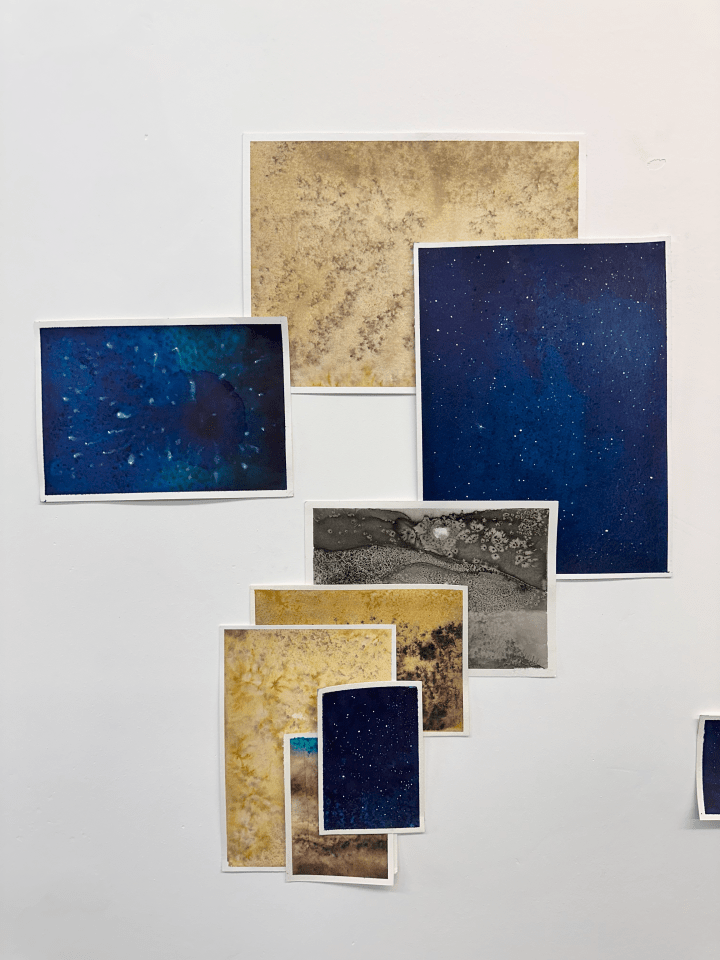
As an audience, I enjoy the uncertainty of not being able to tell whether a work is a painting, a print, or a photograph. This feeling is especially strong in the drawing pieces a part of the work titled “In the Shadow of the Lost Light.” Could you tell us about the materials and techniques you used in your production process?
DE: In the painting series, some works are shaped through direct intervention, while others emerge from the reactions of the materials on the surface. Within the conceptual framework of the exhibition, we reflected deeply on concealment, seepage, and the thresholds between the visible and the invisible. This threshold state also became a defining element in the paintings. I pursued traces that cannot be formally defined, but they are intuitively felt—marks that don’t fully reveal themselves at once. The blurriness and ambiguity that appear on the surface formed the emotional foundation of my process. That’s why I used materials like alcohol, salt, and baking soda along with ink, allowing the surface to break apart, become slippery, and blurred, so that the painting could establish its own space of resistance and openness.
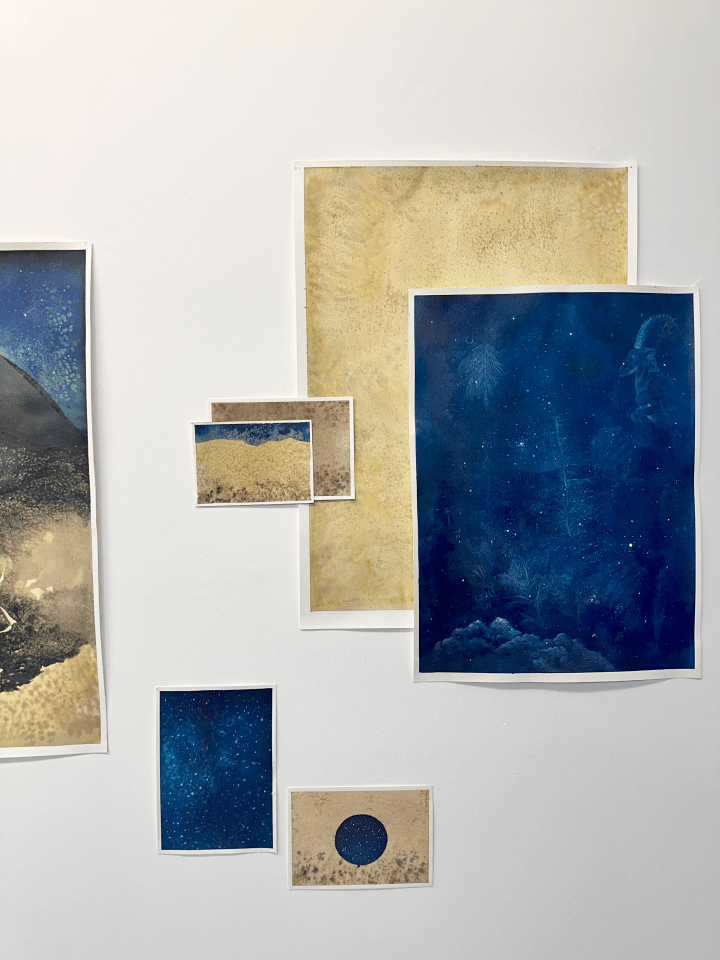
You mentioned using multiple layers of materials such as ink, water, and salt in the making of this work. Naturally, when applying so many materials to a single paper surface, the paper reaches a saturation point and starts to ripple. Additionally, you’ve arranged works of different sizes by layering them on top of each other, creating a presentation that resembles a collage also pointing to concealment and uncertainty. This gesture both separates elements into layers and veils them by overlapping. This was the second aspect that led me into uncertainty. What was your intention while constructing the work in this way?
DE: The layering of the paintings, their overlapping and interactions, closely mirror the production process itself. These works, displayed under low light, are once again veiled within the dim exhibition space, both physically and conceptually. While some paintings possess a mature and dense surface, others take part in the exhibition with their uncertainties and cracks still intact. I often used ink as a kind of cover; yet some images seeped through from beneath it, forcing themselves into visibility. Some works stand on a threshold—neither fully repressed nor completely revealed. The weariness and fragility created by repeatedly applying ink become visible on the paper itself. With these physical effects, the display format also took shape organically: layered, overlapping, sometimes obscuring, sometimes exposing the surfaces.
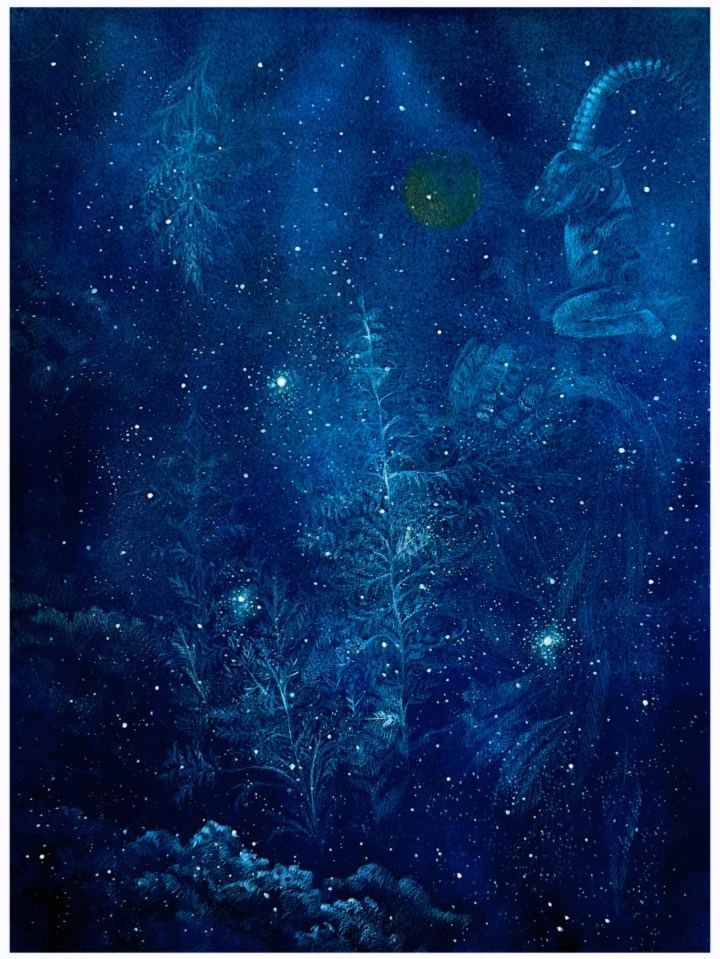
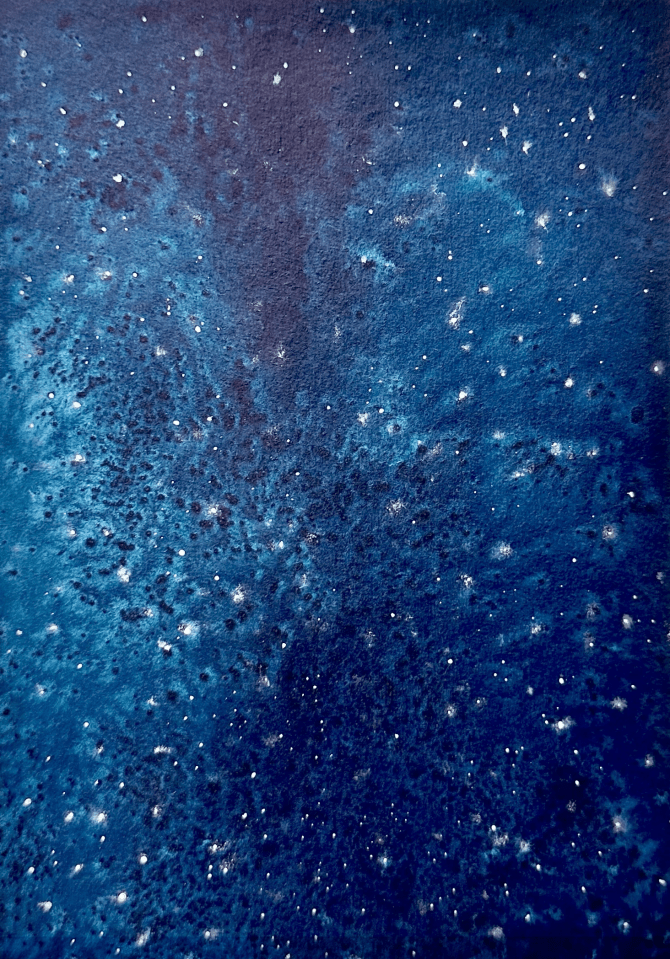
I choose materials intuitively, allowing each work to determine its own form. I value an art practice that unfolds in layers and sustains continuity.
Delal Eken
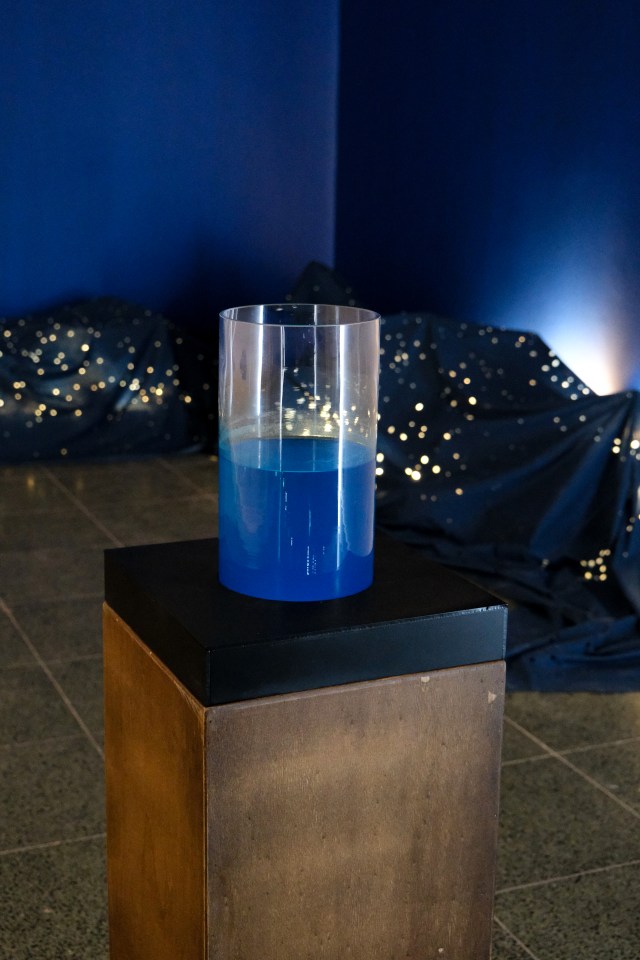
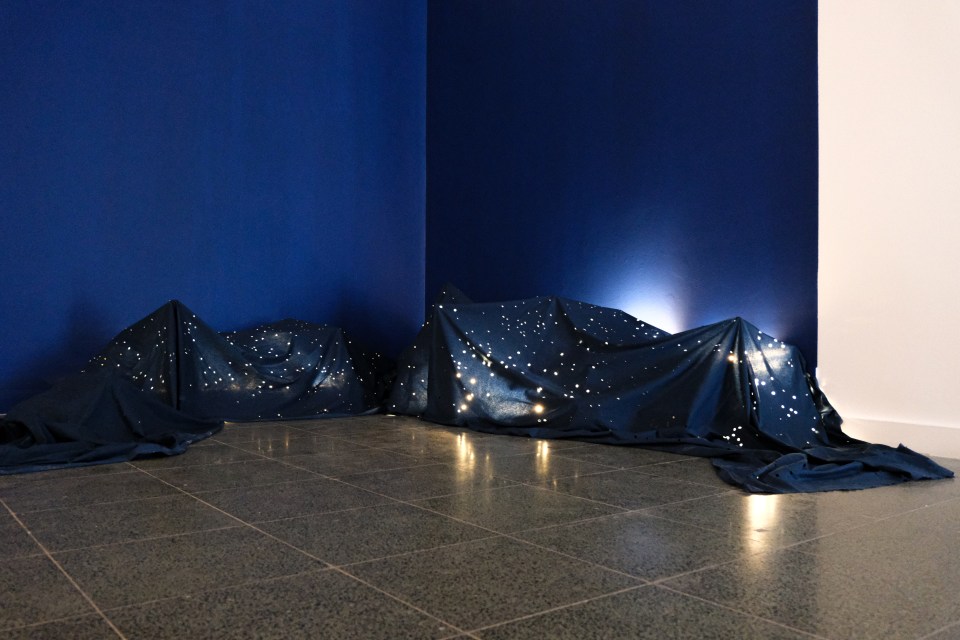
In your other two works in the exhibition, light plays a central role, and I quote you from the exhibition text that the light itself is more important than its source. However, when I lsaw the works, “In the Shadow of the Lost Light”’ and “Blue Well,” it occurred to me that you imply the lights, as a source, appearing from beneath the cover might actually be more important than the light’s itself. What do you think?
DE: In these works, light does not act as a revelation, but rather as a trace that passes through what remains in shadow. Even though its source is not visible, I try to think through the tremor, shimmer, or leakage it leaves behind. In the installation “In the Shadow of the Lost Light,” the light refracts from beneath the surface, transforming into a search accompanied by a fragmented form. In Blue Well, the video hidden beneath water and ink recalls the distance we hold with what is repressed, through the surface where the light seeps in. In both works, light persists as a trace that has lost its direction but still makes its presence felt, attempting to pass through what is veiled.
Light is a phenomenon that reflects off different surfaces with varying intensities after leaving its source, sometimes losing its strength or retaining it. At the same time, without light, it is impossible for us to see. You have various works that involve light, including pieces where you illuminate garbage bags with decorative lights. I’m curious about the role this gesture of illumination holds for you. What do you think remains in the dark in the objects you light up? Or, as viewers, what do you want us to see?
DE: This question touches the core of my creative process. The starting point of this exhibition emerged from my works, which gained visibility through light, portraying the hidden reality of waste, whether it is discarded, suppressed, or forgotten life stories that have always resonated with me, both personally and artistically. This sense of shared fate with objects led me to reflect on a broader state of obscurity.
At the base, at the very bottom, forms of existence thought to be dead and repressed events find presence again—no matter how veiled—through a glimmer of light or in another form. For me, the issue lies precisely in this act of seeping through. The layers and blurriness in the paintings, the uncertainty in the installations, the in-between nature of the video. When considered alongside the beams of light filtering in through the curtain that darkens the exhibition space, the experience is shaped not only by the question “What are we looking at?” but also by the question “What are we unable to see?”
Deniz, I’m curious about your decision to title the exhibition “Beam.” In the exhibition text you prepared, you mention an intriguing layer of meaning. Could you elaborate on that a bit?
Deniz Özgültekin (DÖ): In the exhibition, visitors encounter familiar images, but they are layered beneath different objects. In the paintings, it is ink; in the installations, it is either fabric or water. All works have a connection with light in their own sense. There is a tension between the light and the layers that hide it. Light tries to come out, layers try to keep it beneath. The word “Beam” means a bundle of light in Turkish. In earlier dictionaries, it was referred to as a bundle only. Then, a shift in meaning occurred, as “light” was included. It is uncertain when and how this shift happened. So the daily usage is no longer possible, as a poetic stance is added to the meaning. However, once the current meaning arises, the functionality is lost. I believe that the word “Beam” carries a similar tension with the works in the exhibitions. The connection through the question of light was also vital for us.
From the curtain at the entrance of the space to the way light disperses as beams in the works, we in a sense experience Heidegger’s phrase “the cracks of the earth.” What were the concepts you relied on while deciding this exhibition setup?
DÖ: As mentioned in the text, the works are demanding. They demand darkness and an atmosphere. If not, the visitor will not be able to see how the light is leaking. We preferred not to have strong lights that would illuminate the space. Once we faced the necessity to block the light coming from the façade of 5533, we tried to find the most preferable solution. The black curtain blocked the light significantly, but it also blocked the view. The exhibitions in 5533 are usually observable even without entering, so welcoming by nature. We took the risk of getting mistaken for being closed or being slightly less welcoming by using the curtain. However, I think the curtain itself has a different effect, where the visitors have to open it and move through. It isolates the visitors from what is outside. The curtain also created its visuals by letting light leak into the exhibition space. I enjoyed that every visitor had an impact on the atmosphere to a unique degree by leaving the curtain open.
We wanted this exhibition to have a meaning, a concept, but we also avoided lecturing the visitors. The visitors should be able to relate to the works with their senses, emotions, and instincts, without “understanding” the meaning.
Deniz Özgültekin
We see paintings, installations, and one video installation in the exhibition. What did you consider when selecting these works for the exhibition? What do you hope the viewer perceives when encountering works in different media?
DÖ: We did not prefer one medium over another. I may argue that throughout our almost two-year process, we never spoke about the media. Some artists are strictly focusing on one medium like painting or video, but some do not. Yes, there is more than one medium, but I am not sure if the plurality of media changes anything in how the exhibition is perceived. A discussion about ideas and how to reflect them through works were our priority. One thing I can say is that throughout the process, I think I am lucky to witness how Delal reconnected with painting. Her experimentations with the medium made her explore new ways of expression in the exhibition.
It was a great pleasure to hear the works from both you and the artist during our exhibition visit, thank you once again. One thing especially caught my attention. While discussing the works, you frequently used the word “bury.” I realized that, in general, we tend to assume that art and the artist engage in a kind of speculation on the invisible, an effort to lift the veil over what remains hidden. In your opinion, what is the artist burying in these works?
DÖ: Delal buried different things in this exhibition, but mostly the light. However, we do not prefer to name the source of light. What is buried is up for discussion. We have no intention of imposing a strict meaning, despite some solid meanings being hidden in small details. Visitors can trace the hints, or they might carve their own way. We wanted this exhibition to have a meaning, a concept, but we also avoided lecturing the visitors. The visitors should be able to relate to the works with their senses, emotions, and instincts, without “understanding” the meaning. We never wanted this exhibition to be didactic. The guide in the act of burial can be this question: how does the light react to being buried? Because the light is never gone in the exhibition. In the paintings, you can see the salt “winking” as visitors move their gaze among the paintings. Stars in the paintings do not go fully dark. In the installations, light is still visible despite being buried. The reactions of the light might provide us with patterns. I think the visitors can follow the patterns and create new meanings that are not strictly what we think. The process of creating new meanings follows a simple question: What is buried? Such a question automatically creates a hierarchy of beings: ones that bury and ones that are buried. For us, this hierarchy was a hierarchy of values. What/who is valuable, what/who is not? After all, what/who is not valuable are the ones that are buried. Visitors can fill in the blanks as they wish at the exhibition. So when you ask, “What is the artist burying in these works?”, your answer is more important than mine.
 Burak Mert