Last week, I had the opportunity to attend the event Regenerative Capital: Impact and Future Meeting organized by Onarım Atölyesi | Regenerative Impact Space. Inspired by the rich discussions, I prepared a two-part text reflecting on my experience. The first part focuses on sharing key highlights and insights from the event, while the upcoming second part will explore the positioning of arts and culture in creating social impact and how they can contribute to shaping regenerative economic models.
Measuring the social impact or social value of Gate 27 to its stakeholders has been my focus for the past couple of years. It is both a simple and intricate process to understand the created value, as it is a subjective evaluation by the receiver based on relative criteria, meaning each individual may experience a different level of impact. The process I have been through proved to me that arts and culture are not merely leisure time occupations; they are, without a doubt, the primary resources to create social impact compared to other activities and tools.
Social Value International offers a methodology to understand and measure social impact. This methodology also enables the conversion of social value into financial metrics, which means that spending every 1 unit of currency creates 2 or 3 units of value in the same currency, thereby generating positive social value in terms of financial metrics. The process requires further explanation; thus, I want to pause at this moment, as this introduction is sufficient to present the essentials of social value/social impact.
Understanding or defining impact varies among sectors and stakeholders. It is clear that the profit-making industries heavily employ Environment, Social, and Governance (ESG) measurement, which has also been required at the governmental level, accompanying financial reporting. Understanding and presenting the positive and negative outcomes of business activities at the environmental, social, and governance level helps us understand the effects created for non-business stakeholders.
Today, we are facing new challenges brought by the climate crisis. And, “E” of ESG measurement comes to the fore. Without hesitation, we must keep our earth and resources sustainable if we want to continue living and creating on this planet. This led to an inevitable intervention of governments toward dealing with these issues. For example, the European Union increased its level of environmental protection investment from €51.6 billion to €75.6 billion between 2006 and 2024.1 Also, the private sector investment in the European Union increased to 61.4% in 2024 from 55.6% in 2006.2 Environmental issues are by far the most critical challenge we are facing today. However, the problems we are experiencing are not just about the environment; they are also about social issues, which necessitate rethinking the social aspects connected to the way we live, produce, and regenerate, as well as positioning arts and culture to explore solutions for them.
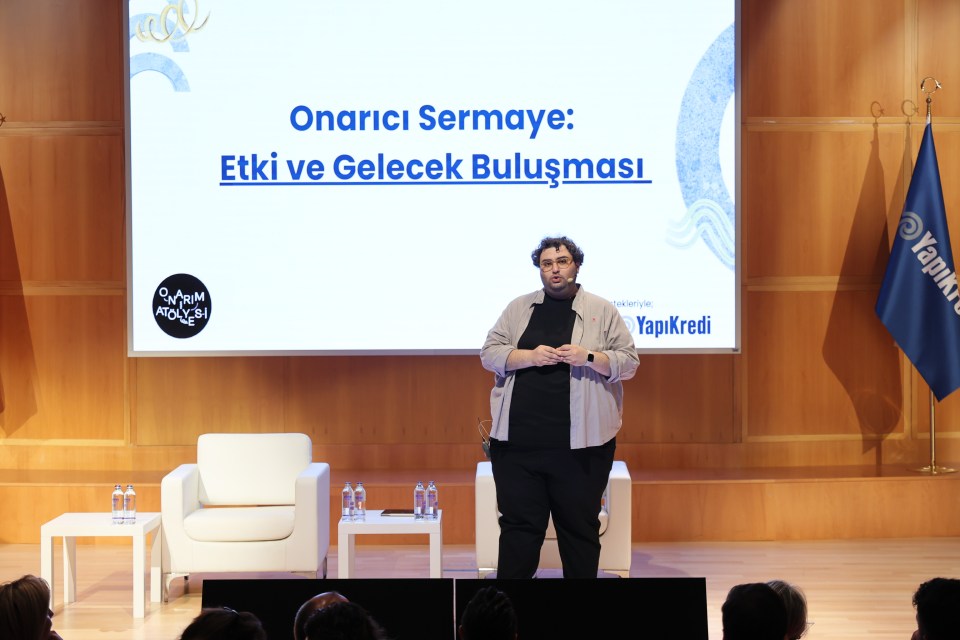
Onarım Atölyesi | Regenerative Impact Space organized an event, titled Regenerative Capital: Impact and Future Meeting, to shed light on how capital investment could shape the world, and investors’ primary concerns arise due to climate change and social problems. I have been following the Space’s founder, Ekin Al, and we have had several “regenerative” exchanges in the past, related to the positioning of arts and culture among recently developed economic paradigms that emerged in response to the environmental and social challenges. It was motivating to see that arts and culture are not merely a leisure activity, yet they can be used as a tool to augment impactful activities. Before delving into arts and culture, let’s take a look at the highlights from the event.
“Shall we talk about impact investment
or investment bringing impact?”
The question echoed in the room during Ekin’s passionate presentation about why we desperately need impact investment today. The question intrigued me as I have been trying to understand the current position of the institution I am leading, Gate 27, in terms of impact creation, and form a manageable version of social impact measurement by the institution.
The business world undoubtedly looks for ways to keep its operations legitimate and accountable in the future. The waste generation, efficient use of natural resources, and redesigning their operational structure, together with the infrastructure, to align cost efficiency with environmental sensitivities, are the prominent actions taken. The attitude was evident from the start, particularly in the first session of talks.
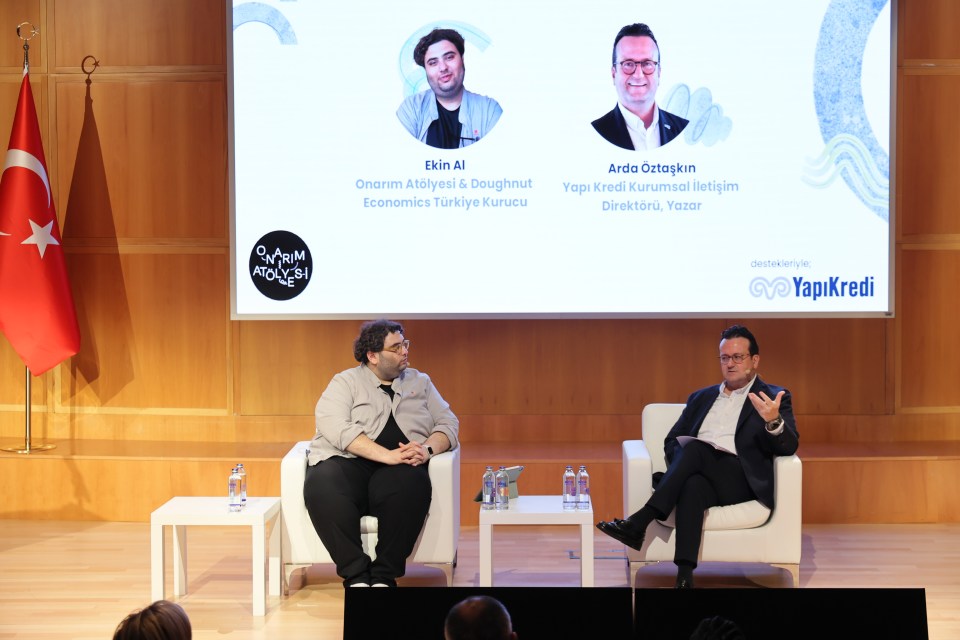
During the first sessions, Ekin had a conversation with Arda Öztaşkın, the Director of Corporate Communications at Yapı Kredi Bank, focusing on the notion of “growth.” Öztaşkın emphasized that developing a holistic approach is crucial to address the world’s current problems and develop strategies to combat them. Öztaşkın stated that the climate crisis decreases the European Union’s GDP by 3.5% annually. He exposed the emergence and background of the current economic system and how it led to the issues we are having today. He stressed the need to redefine ethics and moral values to address the problems in the poly-crisis era we are living in, and focused on social impact, fair distribution of economic assets, and redefining success. As a cultural professional, I believe redefining these notions is essential and offers a perspective of repositioning the “S” of ESG measurement in the impact valuation.
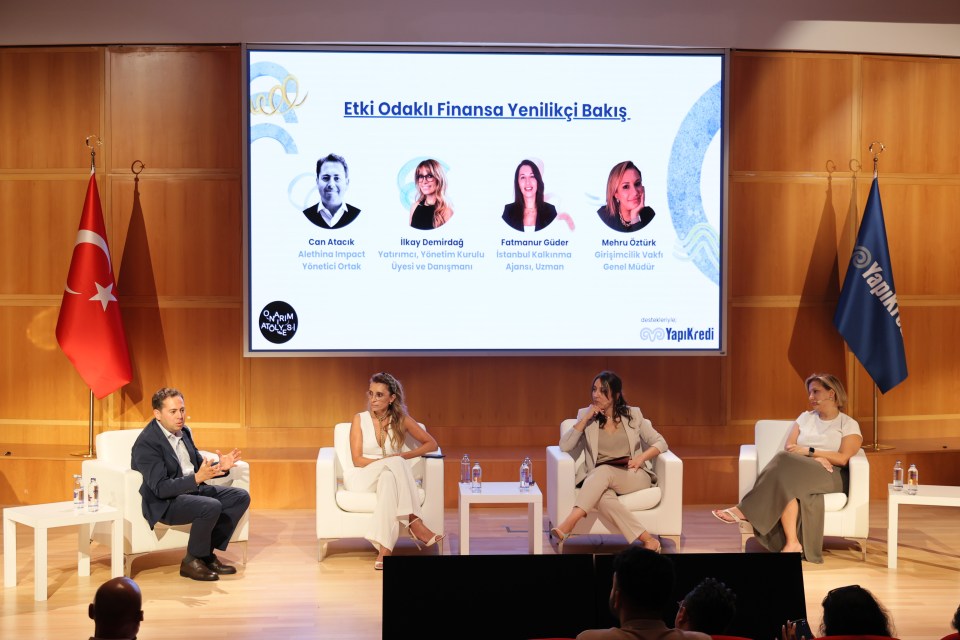
The second session focused on impact-oriented financing and was moderated by Can Atacık, the Managing Partner at Alethina Impact. The speakers were İlkay Demirdağ, an investor and advisor; Fatmanur Güder from the Istanbul Development Agency (İSTKA); and Mehru Öztürk from the Entrepreneurship Foundation. İlkay Demirdağ mentioned how the responsible capital steered the wheel toward the opposite direction after the change in governance in the United States. As global uncertainties rise, businesses put aside their ESG activities, which are heavily focused on the environmental side. Fatmanur Güder highlighted an alternative method of mediation for impact investment. At İSTKA, they started to invite another investor who could take the operational lead and risk management, and required the investor to double İSTKA’s promised amount of investment. In this way, İSTKA started to manage its project at lower operational and financial costs, increased the government revenue through taxes generated in the system, and increased its impact through this new set of KPIs. Mehur Güder’s focus was more on the investment in the start-up side. She emphasized that investing in impactful start-ups and targeting those that create impact yields the same profit as investing in regular businesses. Güder’s note on investment return is an important fact as it erodes the preconception that impact-oriented companies incur high operational costs and therefore generate less profit, which would eventually result in a low investment return rate. Even though all the speakers presented different façades of business life, they all agreed that the impact-creating businesses are still in the profit-making game; yet, they are the mindshifters aligning with contemporary needs at different levels.
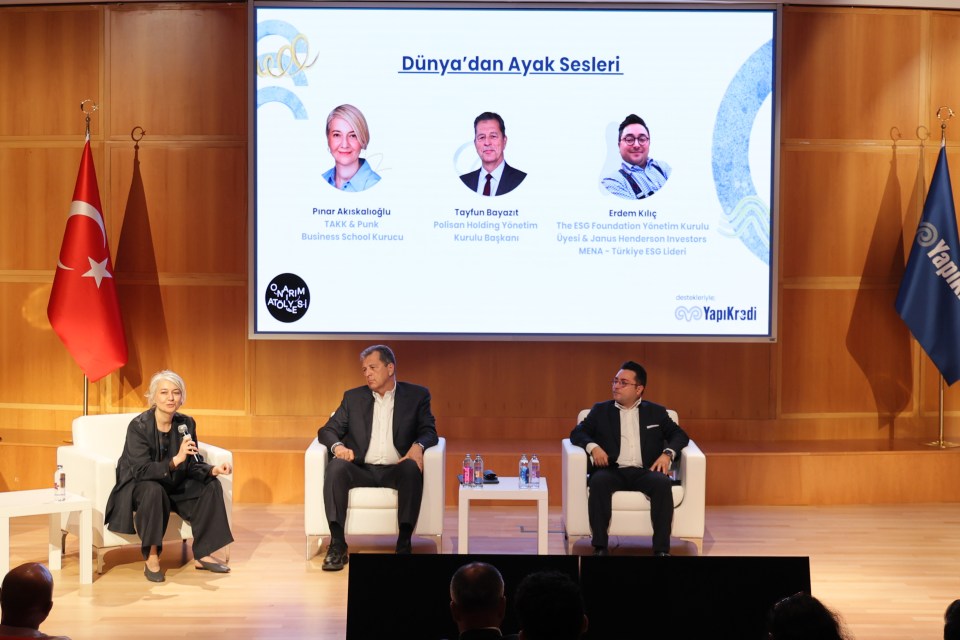
Pınar Akıskalıoğlu, the founder of TAKK and Punk Business School, moderated the last session. The speakers were Tayfun Bayazıt, the Chairperson of the Executive Board at Polisan, and Erdem Kılıç, the Board Member at ESG Foundation and ESG Leader at Janus Henderson Investors MENA – Turkiye. Tayfun Bayazıt argued that there is an apparent decrease in ESG measurement efforts, which causes the criticism that sustainability has fallen as a trending topic. Yet, he added, the geopolitical problems required immediate attention. Now, it is time to separate the ones that are taking environmental and sustainability issues seriously from the others. Pınar Akıskalıoğlu agreed with these comments, adding that the ones on the show side of sustainability have already left the scene. The prominent moment of Erdem Kılıç’s speech was his comment on investment as a practice itself that can create impact. His role has been leading the investors toward conscious choices, and it seems like the tables have turned. Now the investors brief him to diversify their investments around sustainable firms.
The event successfully portrayed where the business world, investors, manufacturers, start-up supporters stand on impact creation and their understanding of impact. I left the event convinced: ESG measurement efforts are essential, and the current focus on environmental impact will shape the future across industries.
On the other hand, there was a gap between the panelists’ emphasis on environmental impact and their neglect of social impact. Even though Öztaşkın suggested a holistic approach toward sustainability and impact creation, it is apparent that the industry has a long way to go to fully embrace this ideal. As a cultural professional who works at the intersection of art, science, and industry, I believe that arts and culture can fill the gap between environmental and social impact focus. I will focus on the social impact and the positioning of arts and culture in the process of impact creation and expanding their integration into the economic system in the second part of the series.
Resources:
1 Investments for environmental protection by environmental domains, EU, 2006-2024 https://ec.europa.eu/eurostat/statistics-explained/index.php?title=Investments_in_environmental_protectio
2 Investments for environmental protection by institutional sector, EU, 2006-2024 https://ec.europa.eu/eurostat/statistics-explained/index.php?title=Investments_in_environmental_protection
 Burak Mert