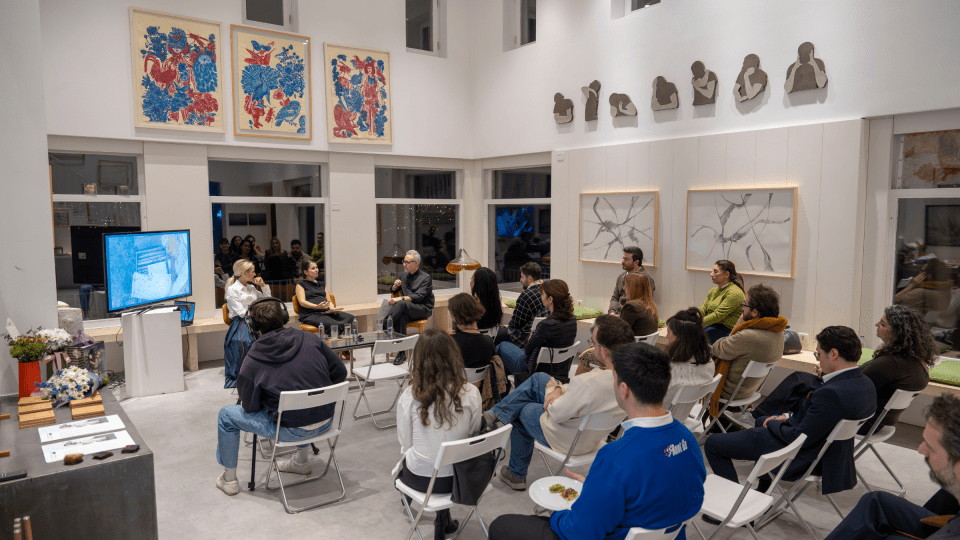
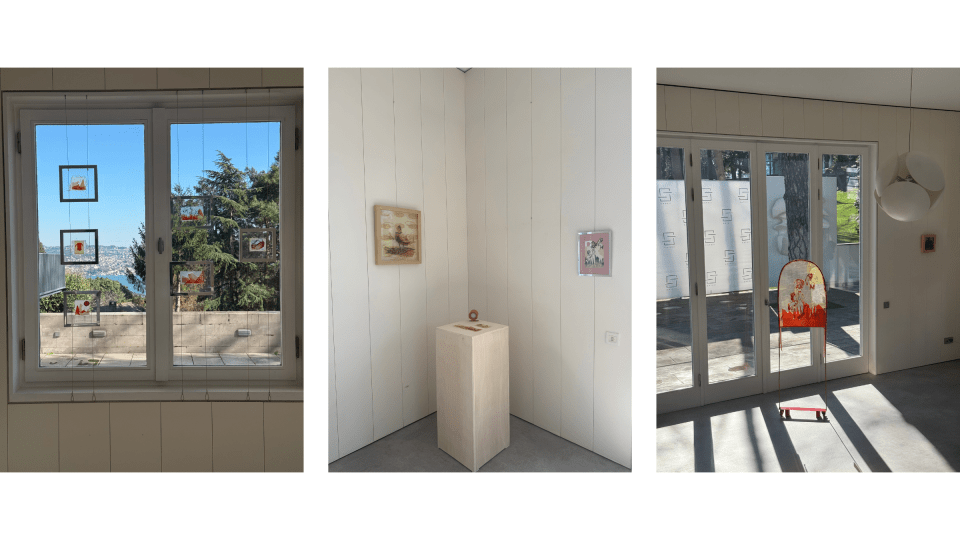
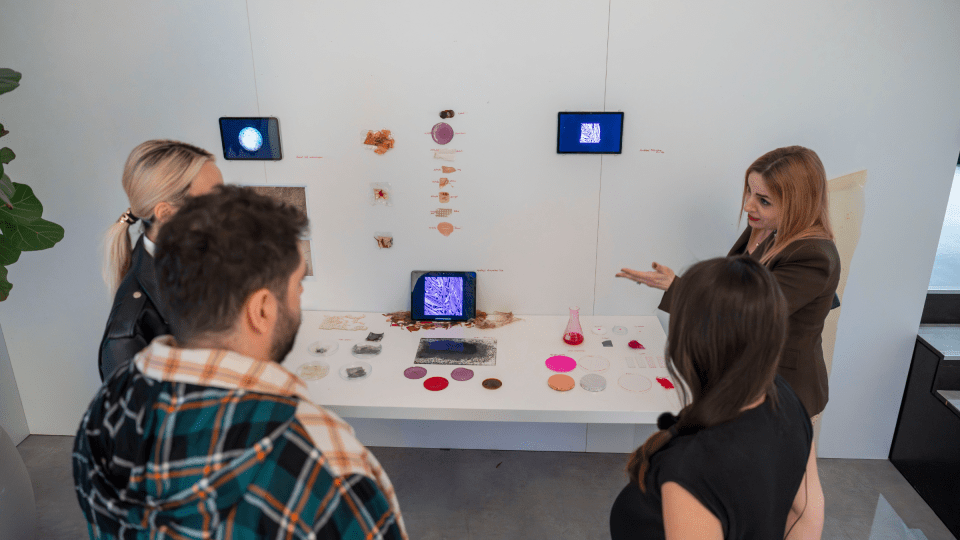
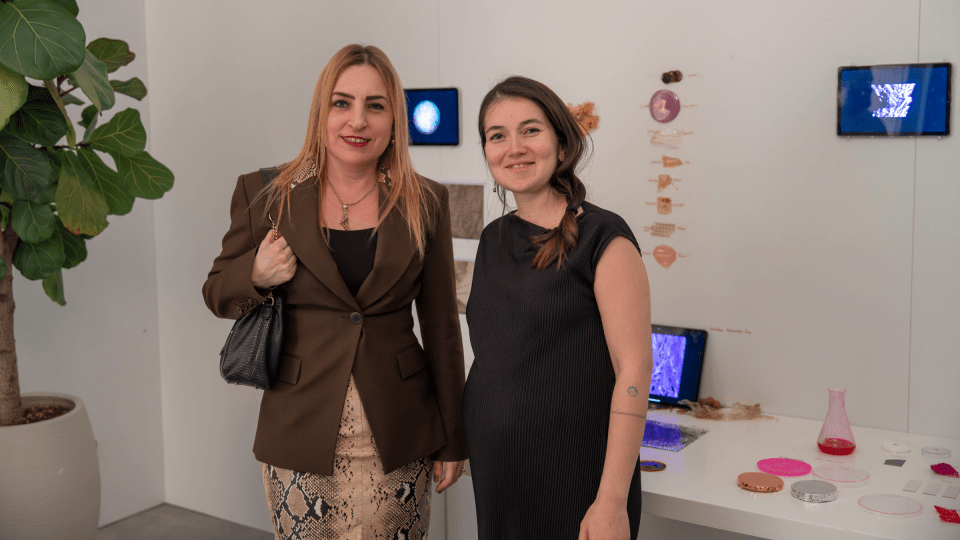
On February 19, 2026, as Beyza Durhan’s residency at Gate 27 was approaching its conclusion, we came together for an extended conversation reflecting on her research and artistic practice. The event, which also featured works produced during her residency, drew significant interest and participation. In this sense, the residency evolved beyond a purely process-oriented experience into a comprehensive period during which we were also able to engage closely with the artist’s tangible productions. The audience’s questions and reflections greatly enriched the discussion. Because I felt that this exchange—spanning biomaterials, collaboration with non-human beings, deep ecology, and coexistence—deserved to remain as part of the archive, I wanted to transform it into a written interview. I hope readers will also enjoy the conversation and discover new perspectives on engaging with Beyza Durhan’s practice.
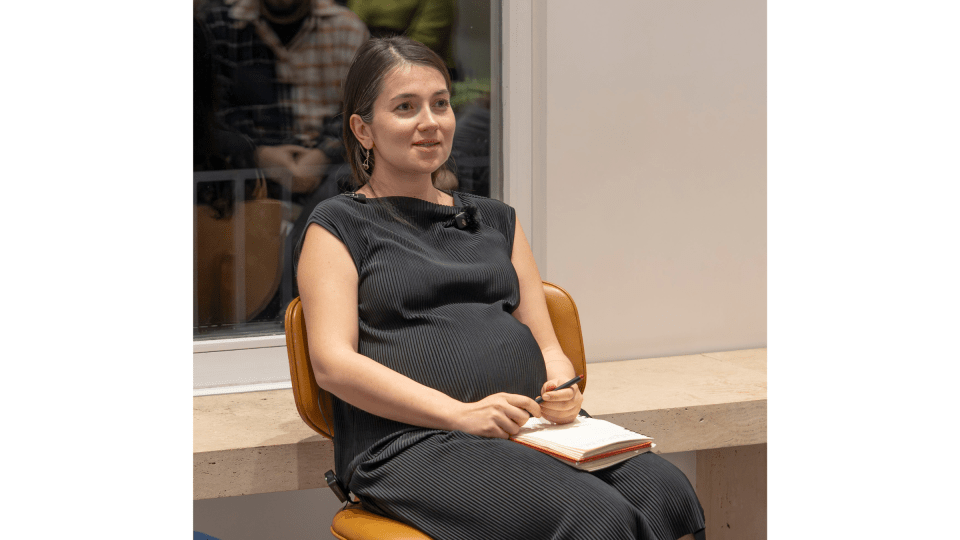
In your artist statement, you describe your role as an artist as “facilitating transformation rather than exercising control.” This is a broad and, in some ways, slightly unsettling position. It suggests a conscious decision to step back from one’s own agency as a producer or creator. How would you describe your artistic practice from this perspective?
For a long time, collaboration has been at the core of my projects. I shape my artistic practice around questions such as: “Is it possible to collaborate with the non-human? Is this physically and genuinely possible?” The materials I work with also expand within this framework. In fact, I often hesitate to even call them “materials.” Because I adopt an artistic practice in which I try to move away from the position of the artist as the sole authority and creator, and instead explore ways of sharing that role. For the artist to share their position also means sharing control with the other. Naturally, this can be unsettling, since human beings are inherently afraid of losing control. Like everyone else, I am also an anxious and uneasy person in my own life—whether living in large cities, being in nature, or trying to sleep in a tent. Because there are always countless things happening around me that I cannot control. The fear and anxiety I experience function in a very primitive way: they keep me alert, and ultimately, alive. While trying to cope with all of these emotions—both internally and within the country I live in—and while simultaneously finding relief in nature yet also experiencing its unsettling aspects, my practice has inevitably transformed.
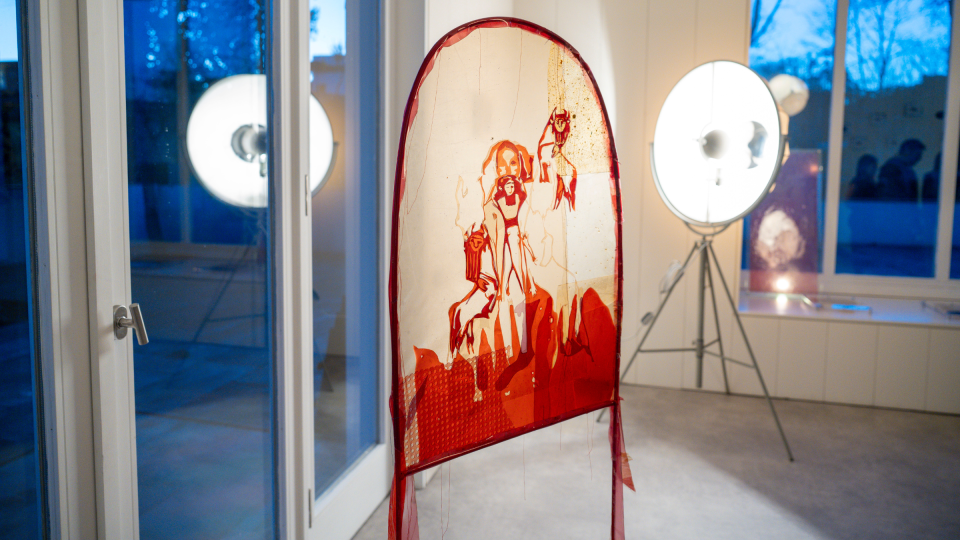
In general, I see my practice as very similar to human existence itself. The fact that it exists within a frame resembles this “second world” we have constructed for ourselves as life. But what I am actually trying to express is a process in which I share control with them, and ultimately accept a relative loss of control. In the works produced at Gate 27, you can see forms that bear the touch of technology—forms that I cut, shaped, and designed. However, we share the state of being the subject with the material itself. In other words, we construct one another mutually and collectively.
There is no varnish or fixative on the biomaterials I create—nothing that promises they will remain unchanged a hundred years from now. A small patch of mold in the space may spread onto one of my works. Their colors may fade in the sunlight. They may transform in shape. I believe that the core concern of deep ecology is precisely this coexistence and co-construction. So, in summary, I could say that within my artistic practice, I am engaging with one of the branches of deep ecology.
Adopting a non-anthropocentric approach in your practice has clearly led you toward working with biomaterials. At the same time, not being fully in control of the material—allowing it to behave according to its own nature as it takes form—seems to be an integral part of this approach. How did you decide to work with biomaterials, and what kinds of impulses led you in this direction?
Since childhood, I have lived a hybrid existence between the city and the wild, and for the past five years, I have actively continued to live in the wild in Şırnak. The observations I have made there, along with my journeys between different geographies, have given me the opportunity to deeply observe how everything is built upon and interconnected with one another. Positioning the human somewhere away from the center, and doing so through the language of materials, is one of the outcomes of this hybrid life I inhabit.
Please consider this as a continuation of the first question as well. For example, Ankara is a completely flat geography—or at least the area where my village is located is—making it highly suitable for agriculture, especially for growing barley and wheat. People there generally own cattle. You can see figures working all day long across vast fields. Working those fields also brings pesticide use with it. Farmers want to maximize yield with minimal loss, because in such enormous fields, they can only profit through scale.
Şırnak, on the other hand, has harsh, steep terrain full of rugged rocks. Not only politically, but nature itself is also sharp and severe. People do not have flat lands suitable for cultivation. They mostly raise goats and kids because cattle cannot climb those steep rocks. Their livelihoods depend on beekeeping and small livestock farming. In parallel with all of this, the air there is incredibly clean. I am sure it was even cleaner a few years ago.
Without going on too long, there are also the bees living in both of these regions, and each region has its own bee ecotype. These ecotypes evolve according to the plants specific to the region. For instance, depending on the crown length and stem depth of a flower, the tongue length of the bee ecotype changes. Or, according to the depth of pollen within the plant, the hairs of the bees in that region become longer or remain short. Through all these observations and pieces of knowledge, the idea that everything mutually constructs one another led me both to the question of collaboration and to working with non-human beings.
There is one very important thing here that can easily be misunderstood, and I feel I should clarify it. In order to collaborate with biomaterials or with a non-human living being, you first need to truly know and understand the living entity or material you are working with and experiencing. Because if we are talking about collaboration, then we are also talking about communication. And for communication, we need to develop another kind of language—one that is free from the limits determined by humans. What I am trying to do is to develop that language by collaborating with the subjects of nature itself.
I’d like to talk a bit about the visual qualities of your work. At times, the imagery recalls cave paintings; at others, it resembles shadow play. The works you are currently exhibiting at Gate 27 also shift in character depending on whether they are exposed to light or left in darkness. Much like in a cave, one might need to illuminate these drawings in order to see them. Is this a deliberate reference?
These places are also the source of the forms that nourish me aesthetically. It makes me very happy that this can be perceived in the work. Once again, I do not think the “self” that is shaped by unease and anxiety in nature is very different from the instinct of the cave painter. There is a nature I cannot fully cope with, a nature I admire, a nature in which I struggle to survive, try to understand, and fear, yet ultimately can only sustain my life within. I am the primary experiencer of this nature, and I select and extract certain images from it.
But then, why did I feel the need to do this? Was it a ritual? Was it related to belief? Or am I simply sharing an experience? For some reason, including my previous answers, I feel the need to express the entirety of what I have been describing. I think this urge to express is rooted in the same primitive feeling brought on by the anxiety I experience in nature. This is the point at which I identify intellectually with the cave painter.
At the same time, I am deeply nourished formally by stories, myths, fairy tales, and cave paintings. I relate today’s myths to the myths of the past. At the core of this, once again, is the question of mutual construction. In other words, I, too, place a small stone—within the limited span of today’s life—into that which is transmitted from language to language and visually across time. Just like all of us do.
The idea of the cave changing with daylight or fire, meanwhile, can only preserve its existence by making the material itself a subject.
Thinking about caves inevitably brings to mind Plato’s Allegory of the Cave. In this metaphor, human perception is likened to that of people confined to a cave, mistaking shadows for reality. Plato describes what we see as illusion and forms revealed through light as mere reflections. In your work, it feels as though you are attempting to reveal the ideas of the material—or, in other words, its latent potentials. How do you respond to this interpretation?
Yes, I like that metaphor. The idea that reality is limited only by the senses supports the notion of mutual construction that I have been talking about. At the same time, it positions itself for me as a response to the inadequacy of anthropocentric forms of communication, which I stand against through collaboration.
The bioplastics I work with already possess a kind of character of their own. They also transform according to the objects they merge with and, in turn, guide me. For example, in Şırnak, plants that I boil for the exact same amount of time and in the same proportions dry overnight and harden immediately, whereas in Istanbul’s humid air, the process takes much longer. Sometimes they even develop mold. The surface on which I dry the material is also extremely important. On a matte surface, the material remains matte; on a glossy surface, it becomes more translucent. These are all part of the material’s own physical existence and reactions.
And then there is light. The structure of the material becomes more or less translucent depending on the surface onto which it is poured. Yet when layers accumulate on top of one another, both the color and the depth change, and the tones multiply. To make this visible, the material also needs light. In the works that emerged during the Gate 27 process, the morning appearance and the evening appearance are completely different. Physically, the material is actually standing in exactly the same form. What changes is only the reality we perceive, according to the light.
At that point, gaps begin to emerge between the reality I create, the reality I see, and the reality I present. I think this once again reinforces the idea that everything exists through one another.
As the conversation moves from Plato outward, it also seems relevant to touch on Stoic philosophy, as well as Eastern thought and belief systems. Particularly today, as sustainability has become central to our lives, we are being reminded that we exist in deep integration with nature. The rigid boundaries imposed by modernity are gradually dissolving. Your work similarly engages with the relationship between the human and the non-human. How do you understand your relationship with materials from this perspective?
Both the biological structure of human beings and the human mind contribute to the order of nature. At this point, Stoic thought proposes not controlling the world itself, but controlling how one responds to it. Reading ecology merely through the lens of things humans protect, or solely through sustainability, does not feel sufficient to me anymore.
What I am saying does not come from a place of underestimating or trivializing the destruction humanity has caused. Rather than taking a superior stance and saying, “Look how I am transforming everything into something else,” I think it is more about acknowledging that, at this stage of the world, “we are evolving together with nature, and for a very long time I have been spending enormous energy trying to take control of it.”
Every living being—and even many non-living entities—strives to survive and sustain itself. According to biota, this can only be possible through togetherness. While being together, adding the question “how do we coexist?” feels very meaningful to me. Human beings, as creatures capable of connecting past and future, can also choose how to weave those connections.
I am essentially trying to understand the relationship between the human and the non-human through a perspective that serves the biota. While doing this, I cannot entirely let go of my desire to control or my urge to express myself, but in the end, the material decides what will happen. And even the material cannot decide on its own. The temperature of the air, the geography it exists within, and humidity—these non-living factors also become subjects with which the material collaborates.
Bees, honey, and beeswax appear frequently in your work. Could you talk a bit about what drew you to bees and their products? What kind of conceptual role do they play within your practice?
I was born into a family of beekeepers. My encounter with bees was not something I consciously chose, nor did I begin researching them simply out of curiosity. Since childhood, under many different conditions, bees have probably been the non-human living beings I have observed most closely and know best. At first, this was simply part of life itself.
After entering the Faculty of Fine Arts, I began using beekeeping materials on canvas. During my undergraduate years, I approached these materials by transforming them into metaphors. Later, during the pandemic, when I actively returned to village life, I realized that the bee and its material were not metaphors at all, but the subject itself. That was when I first began asking the question of collaboration.
This may sound a bit detailed, but bees biologically have a specific season for building honeycombs. Although this changes with nature and timing may vary, let’s say we had a good winter: the soil became saturated with snowmelt nitrogen, spring brought nourishing rain, the sun came out, no late frost hit in early spring, and summer arrived. Somewhere around June or July—roughly speaking—bees biologically focus both on increasing the hive population and on building combs. During this period, they do not make honey. They are occupied with reproduction and construction. At this stage, the beekeeper provides them with frames and wax foundations so they can grow more comfortably.
With all of this knowledge, every year I place organic materials into the hive over approximately one month through questions of collaboration. While doing this, acting in accordance with the bees’ own sense of time and rhythm is a priority in my practice. Because at a temperature of 21°C, under the right artificial daylight and with proper sugar feeding, bees can biologically be inclined to build perfectly formed combs at any time of the year, believing that they are in that specific season.
My aim is not simply for the bees to build combs over the forms I create, but rather to observe the construction process while respecting the bees’ own temporality. I have never had perfect forms. In every experiment, a process that appeared to be under my control—or that I initiated—was ultimately completed according to their will.
Conceptually, I physically experience a process of construction in which the subject continuously shifts: between myself and the bees, but also among the plants that nourish both the bees and me. There is also something else I love to emphasize: bees are still a wild species that humans have not truly domesticated. Today, almost every species that humans regard as a commodity, nurture, and coexist with is ultimately kept within some form of enclosure. But working with bees—because they still belong to the wild and remain wild—requires the human being to cage themselves instead.
When I read your application to Gate 27, I was genuinely excited. It offered the opportunity not only to host a new artist within the context of bio-art, but also—thanks to the comprehensive support of Sabancı University—to enable an in-depth, material-focused research process. My observations suggest that this potential has been fully realized. How has engaging in material-centered experimentation influenced your practice?
In addition to the biomaterials developed at the Integrated Manufacturing Technologies Research and Application Center (SU IMC), we also closely examined the materials I produced using Sabancı University Nanotechnology Research and Application Center (SUNUM)’s extensive microscopy facilities. There, I conceptually met scientists who use these microscopes for entirely different kinds of experiments at a common point of inquiry. That is why I think both the measuring instruments and the act of examining material at the micro scale contributed significantly to the conceptual depth of the works. Of course, physically speaking, I also ended up with a vast visual archive that is ready to evolve into future transformations.
At Sabancı University, there is a highly innovative space inside the library called “Co-Space.” There, I benefited from a wide range of equipment, from laser cutting to 3D printing. The drawings I had initially prepared by hand were transferred to a digital environment and then processed by laser cutting onto the material I produced at Gate 27. This became a process I experienced for the first time within my practice.
Finally, at Sabancı University Art and Social Sciences Faculty (SUSAM)’s metal workshop, we even had time to build a structure out of scrap metal to exhibit these works.
Looking back, the entire process, much like my practice itself, focused not on form but on the material. What I encountered in Sabancı University’s laboratories was both very different from and deeply connected to the experiences in my own studio. One of the things I was most excited to experiment with on my materials was ensuring the longevity of the works through natural substances already found in nature, using laboratory methods. When I shared this idea with the faculty members at Sabancı University, they also created space for experimentation. We focused especially on pine resin, melting and dissolving the material together. Bringing this process back into my own studio has become one of the most important outcomes of my experience at the university.
Ultimately, Sabancı University did not open just a single department or facility to me; it opened every area I was curious about and wanted to engage with.
I’d like to discuss your working process with Sabancı University’s Integrated Manufacturing Technologies Research and Application Center, as well as your collaboration with Professor Burcu Saner Okan. As an academic yourself, how did working with Professor Okan contribute to your practice, both intellectually and technically? Perhaps we could also hear her perspective. She is known for her highly creative work and for producing a wide range of works using organic waste.
Dear Prof. Dr. Burcu Saner Okan is not only an extremely valuable scientist, but also, from what I have observed in a short period of time, a truly pioneering academic. Although our fields may appear different at first glance, we were able to establish conceptual connections with one another very quickly. For this reason, I believe her openness to innovation and her curiosity-driven approach are essential parts of both her production practice and her academic success.
At the same time, it was not only Prof. Okan, but also her doctoral students and team members, who approached me with remarkable openness and generosity. No material or idea was withheld from me. This was inspiring not only for the process I experienced in the laboratory, but also for my own academic journey.
While Prof. Okan approaches biomaterials primarily through an industrial framework, focusing on sustainable production, my own practice takes a more conceptual and artistic approach to these materials. Her engagement with composite and organic materials, given her field of expertise, became one of our main points of intersection. Although our techniques and application areas differ, this difference itself created the ground for a highly productive intellectual exchange.
Independent of the process as a whole, meeting such an academic and having the opportunity to think together—and to sustain that dialogue—has been incredibly valuable for me. I would like to once again thank dear Prof. Okan for inspiring the people around her.
And of course, before that, I would also like to sincerely thank Gate 27 and the entire team whose immense efforts made this whole process possible.
 Burak Mert